Executive Summary
In case you missed it: Anthropic recently issued a bulletin warning against unauthorized stock sales and SPVs. This was an entirely understandable reaction to serious chaos in the private markets.
Why is this happening? $10B+ rounds are too big for any single fund to lead off its balance sheet. The capital must come from direct allocators — family offices, RIAs, endowments, etc. — but it's overwhelming for Anthropic to deal with them all, which naturally brings SPVs into the picture.
Specifically, starting in 2025: as Anthropic's rounds ballooned ($13B → $40B → $50B), the company kept heating up from a PR standpoint, and growth continued at >10x / yr(!), two things happened: allocators started getting even more FOMO, and intermediaries — brokers, GPs, and even multi-family offices — piled in to get a small piece of an absolutely massive fee pool.
A 3% commission on a single $500M transaction is a decade's worth of income to a broker. A 1% annual management fee on a $1B SPV is bigger than the entire firm economics for most managers. We're seeing unprecedented fees even for institutional transactions — 10–20% on tens of billions of dollars. I've never seen anything like it in my decade+ in the space.
Multi-layer SPVs — L2s, L3s — unregistered brokers, and daisy-chained intermediaries have become the norm. Even legitimate people in the ecosystem are having chats with “a guy who knows a guy.”
The core problem
You simply cannot try to raise $10B+ and also prohibit SPVs.
This only got worse due to multiple rounds in quick succession, each one bigger than the last. The capital base needed to fill rounds of this scale is broader than any single lead investor or tight group of institutional funds can realistically cover.
The rise of wild-west “syndication” since 2025
“I know a guy who knows a guy who is direct to the GP.”
Then, when you get to the GP, there’s no evidence they have an allocation because Anthropic hadn’t confirmed allocations at all — and they really meant, “I may have an allocation soon.”
Other patterns:
- GPs asking LPs to submit bids — not just “our fee structure is 1/10,” but “our fee structure is 1/10, but if you’ll do 2/20 I’ll put you at the front of the line.”
- SPVs that look less like co-invest vehicles and more like unlicensed brokerage.
The principle underlying an SPV being a co-invest vehicle is that it has management fees — usually, for a late-stage fund, 2–3 years’ worth — and carry. This round, the vast majority of blocks on offer had an upfront fee, often structured as a “management fee” and usually 12–20% upfront, but zero carry. This is basically just unlicensed brokering.
There is a lot of genuinely bad behavior going on
The worst offenders, in order:
- Genuine fraudsters who don’t have the shares and never intend on getting the shares. These are effectively scams where they collect your money and never secure exposure to the underlying company. These people, obviously, should go to jail. The people investing in these are getting outright scammed and are victims. The “blame” is 100/0 on the scammer / investor.
- Misrepresentation. People lying about the situation: pretending they have already secured the shares when they haven’t yet; pretending they control an entity that has actual shares, when what they have is some other derivative exposure.
They are not committing outright “fraud” in the colloquial sense, but they are committing securities fraud — lying in the context of stock sales — and they will either go to jail or, at the very least, pay heavy fines.
The issue with Anthropic’s bulletin
The language in Anthropic’s bulletin may have unintended consequences:
- It lumps together four very different things:
- legitimate past SPVs
- annoying-but-legal share shopping
- contract-violating synthetic exposure
- outright fraud
- It seeks to invalidate past SPVs, which can be confusing because many SPVs have previously been approved by the board.
- It provides no permitted path, which risks pushing activity further into the shadows.
The better playbook
SpaceX and Anduril have shown how to do this:
- Bless a small set of approved sponsors.
- Ban sub-syndication and nested vehicles.
- Potentially cap fees.
- Enforce consistently.
- Provide a clear golden path rather than a blanket ban.
The goal should be to protect the company and investors from fraud and chaos without making legitimate, necessary capital aggregation impossible
Full post
As everyone has seen at this point, Anthropic put out a bulletin on "Unauthorized Anthropic stock sales and investment scams":
There's a LOT in that bulletin. And there's also much left unsaid — and a lot of arcane knowledge regarding SPVs and private markets — so I'll unpack it in this post.
- All the legal and investment stuff I say in this post is obviously not legal or investment advice.*
There is a lot of genuinely bad shit going on
The worst offenders, in order, are:
- Scammers: Those who don't have the shares and never intend on getting the shares. These people are fraudsters; they collect your money and never secure exposure to the underlying company. Obviously, they should (and hopefully will) go to jail. Investors participating in these are the most unfortunate victims. The "blame" is 100/0 on the scammer / investor.
- Misrepresentation: People lying about the situation: a) pretending they have already secured the shares when they haven't, yet; or b) pretending they control an entity that has actual shares, when what they have is some other derivative exposure. They are not committing outright "fraud" in the colloquial sense, but they are committing securities fraud (lying in the context of a stock transaction). They will probably not go to jail, but will probably pay heavy fines. Investors participating in this should probably be asking better questions; but this stuff is nuanced, and expecting a non-professional to understand complex financial structures is unreasonable. The blame is probably 75% facilitator / 25% investor.
- Egregious fees: People who are layering vehicles, one upon the other; with absurd, disgusting fee structures on top. The sort, where, if the company appreciates by 200% in value, you might only see a 100% gain. They are (usually) being honest about the fee structure, but it still causes harm to an investor (especially a retail investor), because most people don't do math. However, an "accredited investor" is by definition supposed to be more sophisticated, and as a libertarian I don't think we should nanny people. If the facilitator is not lying, the investor is responsible for doing their homework. The blame here is probably 50/50.
All that said, this speaks to a level of chaos which is, obviously, very bad. This has been happening for many years; but over the last year or two, it's been particularly egregious in a small number of highly sought-after companies: SpaceX, OpenAI, Anthropic, Anduril.
The anatomy of a $10B+ round
Why did this start happening recently? Around mid-2025, two massive forces collided and compounded upon each other:
- the tariff wars calmed down, boosting markets
- AI, defense tech, and robotics were clearly becoming very very real, and very, very big
For 20 years now, "companies are staying private longer and raising bigger rounds" has been true; but this was a whole new level. In the last wave, the high watermarks (Airbnb, Doordash, Uber, WeWork, Robinhood, Instacart, Lyft) raised a total of $5-20B each. None of them crossed a $70B valuation when private. Certainly, we'd never seen a single round of $10B+ before 2024. After this round, both OpenAI and Anthropic will have raised ~$100B or more.
Private market dynamics change completely when numbers are cranked up by an order of magnitude. Let me break down why.
Let's say a company is raising a $5B round. This is a big round! But there a number of firms who can underwrite a lead or co-lead check, directly off the balance sheet of their main funds:
- VC mega-funds: A16Z, Sequoia, Lightspeed, General Catalyst, Thrive, Accel, Khosla, Insight, Index, etc. have AUMs of $20-100B — many of these firms can underwrite a $1-2B lead check.
- In "Growth Equity": Iconiq, Tiger Global, General Atlantic, Coatue, Dragoneer have AUMs of $40B-150B — their mandates justify more concentration, so they can write a $2-5B lead check.
- In "multi-asset / sovereign": Wellington, Baillie Gifford, GIC, Temasek, ADIA, Fidelity, T Rowe, Blackrock, etc. have AUMs of $100B - 2T+ but they are extremely diversified, so they are generally only able to write a $5B check or so.
This, obviously, stops being possible on a much, much bigger round. As you can see, there are no investment managers that can write a true lead / co-lead check for a $30B+ round. Even a $10B+ round would be challenging to lead. So when OpenAI and Anthropic go out to raise tens of billions to scale compute, the main funds of even the largest investors in the world simply cannot absorb the exposure.
This is compounded by the fact that many of the funds listed above have already invested in prior OpenAI / xAI / Anthropic rounds; doing more would destroy portfolio construction. (Even Softbank, the only fund we know that likes betting $10B+ in a single company off their balance sheet is probably tapped out; they anchored the OpenAI round last year.)
Which simply means: the capital mathematically needs to come from family offices, RIAs, endowments, etc. By definitioni, this would happen through co-invest vehicles / SPVs.
So: it's confusing for Anthropic to say "SPVs are bad", when they unequivocally need SPVs for the round sizes that they are raising.
So... what's going on?
The rise of wild west "syndication" since 2025
Over the last year, the collective of market participants made a series of rational decisions... but the accumulation of those decisions led the market to unravel into a very broken, messy — and borderline illegal — system.
First, as available pools of pre-committed / main fund / blind pool capital tapped out, Anthropic (and other similar companies) gradually permitted some co-invest situations. (To be clear, I have no direct knowledge, but this much is apparent from the breadcrumbs.)
In 2024, this meant "GPs of legit funds raising from known LPs" and "friends of the company are offering a discreet opportunity to their known LPs". These would have all reviewed and approved by Anthropic's Board.
Then, things started slipping. Gradually, then all at once.
By mid-2025, it became "GPs (of many varieties) taking intros via friends-of-friends and brokers to raise their SPVs" and "2nd layer SPV blocks of $5M being chopped up into $100K checks in a 3rd layer SPV"
There was tell of one foreign GP with a multi-hundred-million dollar allocation last year who was chopping it up and sharing it with a wider audience, and the company cracked down on it. Last fall, they communicated to all GPs, broadly, that they're not a fan of SPVs.
However, as we just discussed, this is at odds with the market. You simply cannot try to raise $10B+ and also prohibit SPVs.
This only got worse due to multiple rounds in quick succession, each one bigger than the last ($13B at $170B last summer -> $40B at $380B in the winter -> $50B at $900B today), the GP lists got wider.
Intermediaries, naturally, got dollar signs in their eyes, and people who aren't brokers started getting in the middle. Honestly, this is only human nature. For everyone involved, the potential fee pools started to look obscene. A 2% annual management fee on a $1B SPV is $20M / yr! A 3% commission on a $500M block is $15M!
In the meantime... Anthropic was also — understandably — publicly and effusively promoting the business: predicting AGI soon, describing Mythos as too dangerous to give away, estimating 10x revenue growth in 2026 (to $100B!)... and most recently reminding us that they beat their own expectations by posting an annualized growth rate of 80x(!) in the first 4 months of the year.
These are normal things for a company to do to build investor interest in their next primary round. It's also very good PR to attract AI research talent in a brutally competitive market.
However, Anthropic is not a normal company to start with.
- There are a small number of companies that have inherent heat: OpenAI, Anthropic, SpaceX, Anduril, Stripe, Databricks, xAI (until recently), etc. They have crossed into the mainstream, and there is a thirst for these names via clean structures and reasonable terms.
- However, the other names on that list have not attempted to generate heat in the last 12 months. The last time a company was this good at generating heat during a fundraise was Snapchat in ~2016. Their late stage rounds were many times oversubscribed because they were very very good at fundraising and PR, but they also intentionally created scarcity during the fundraising process.
2 Weeks ago, Anthropic asked investors to submit bids within the next 48 hours. That is a classic "generate heat" move, and it's a smart thing to do when you know there's interest and you want to get a quick close.
However, when there is already a ton of inherent heat (a la SpaceX), and you also generate heat (a la Snapchat)... the whole thing explodes.
Here are some crazy things from the last two weeks that I've seldom seen before (over 11 years in the private markets, across 1,000+ transactions):
- Institutional blocks with 20%+ in upfront fees. Usually, blocks of >$50M carry 1-3% in fees, this was an order of magnitude higher.
- Glorified brokering being done brazenly by people who are not even registered with a broker-dealer.
- Everyone turned into a facilitator, not an investor. Family offices that would normally deploy capital began pooling capital their friends. Because even 1% management fee over 5 years on a $1B SPV they could assemble with their friends is $50M in fees(!)... and that moves the needle for you, even if you're already incredibly wealthy.
- Investment banks that would normally not run rushed processes started taking bids from everyone, including via brokers.
- Even the good brokers — who try to be thoughtful and have direct relationships with their clients — started working with daisy chains. "I know a guy who knows a guy who is direct to the GP." Then when you get to the GP, there's no evidence they have an allocation because... Anthropic hadn't confirmed allocations at all, and they really meant "I should have an allocation soon"
- GPs asking LPs to submit bids — not just "our fee structure is 1/10" but "our fee structure is 1/10, but if you'll do 2/20 I'll put you at the front of the line"
- The principle underlying an SPV being a coinvest vehicle is that it has management fees (usually, for a late stage fund, 2-3 years' worth) and carry. This round, the vast vast majority of blocks on offer had an upfront fee (often structured as a "management fee", and usually 12-20% upfront) but zero carry. This is basically just unlicensed brokering. In Anthropic's shoes, I would have been okay with a VC inviting their LPs and charging fund economics; I would be much less okay with anyone inviting randos and charging upfront fees to just capture a spread for "access".
And I'm just talking about the institutional stuff: the "L1" blocks where a $100M investor is putting money into a cap-table-SPV. Lots of shenanigans and posturing upfront, but very little possible in shenanigans once you get to the point of funding / closing.
I'm sure the retail market was so much worse with $100K-1M checks in L2 / L3 SPVs.
Everyone just went absolutely crazy.
This is why Anthropic got mad; but IMHO they are overcorrecting
This section is speculative. I'm not in the exec or board room at Anthropic, and I haven't spoken to anyone there. But I've been in the secondary / private markets a long time, and it's very clear what's happening when you read between the lines.
I think there are multiple reasons Anthropic published that bulletin.
First, they obviously do not want fraud, lying, and egregious fee structures. There's probably some lawyering going on saying "we need to disavow this to limit liability".
But that's not all.
The second thing that's happening is the shopping-around of primary shares that is not illegal, but is annoying to Anthropic. It cheapens the perception and value of their stock. It creates confusion and jeopardizes a financing that's happening during a critical time.
The reason I believe this is the main motivation is because of the conspicuous absence of the word “secondary” anywhere in the bulletin. They refer to "transfers" because reselling a stake in an SPV that holds Anthropic shares would be considered an unauthorized transfer. I'm not saying they love secondaries; they almost certainly don't. But I think the main concern they have is their primary round shares getting syndicated out.
But I think the exact way they handled this bulletin will have further unforeseen consequences:
- The markets always find an escape unless you ease the pressure cooker. The correct way to do that is to provide a golden, permissible path on your terms in extremely clear language; and say everything else is banned. By banning "all SPVs" they will just drive SPV activity into the shadows. [Update: this is already happening. GPs and intermediaries are taking the same absurd fees anyway — getting LPs on the cap table while charging upfront fees + carry "contractually"]
• They made incorrect backward-looking statements which throws all prior participants into an understandable tizzy: "Offers to invest in Anthropic’s past or future financing rounds through an SPV are prohibited." A company simply cannot invalidate something ex post facto. And they also cannot say offers in the past are prohibited, because in the very same post they said that only new offerings from Forge and Hiive are banned, which necessarily means that old offerings (via SPV) are not banned. As disclosed in public filings, both these firms (and lots of others) used SPVs to purchase Anthropic shares in the FTX bankruptcy (with Anthropic's full knowledge and Board approval). So, it's very apparently not the case that "all past SPVs are null and void". Further: if a transfer restriction is not conspicuously noted on the stock certificate, the stockholder must have actual knowledge of the restriction before acquiring the stock. You can't simply retcon a transfer restriction into existence.
- They commingled four things as if they are one and the same. I think this will result in more confusion and noise in the market. a) legitimate-and-permitted past behavior (SPVs and coinvest vehicles from the past), b) legitimate-if-annoying behavior (shopping around Anthropic shares), c) sketchy behavior that is a contract violation but not fraud (synthetic exposure that is meant to work around transfer restrictions), and d) outright fraud and scams (people taking your money and running away).
- The inclusion of Sydecar felt odd to me (and others in the private markets). They are simply a fund administrator, and it's the GPs who run vehicles on the platform who are doing legitimate or illegitimate things.
- The good part they covered: scams and lying / misrepresentation are fraudulent. The missing part is the explicit ban of multi-layer SPVs and egregious fee structures.
- IMHO, I think it was a mistake to say all "SPVs are bad" because — as we just discussed above, I genuinely don't know where the capital will come from to fill a $50B round, if not from SPVs, and this risks throwing a wrench in the middle of an active financing round. And it's hard to react to "unauthorized vehicles are null and void", without an obvious way for an LP / investor to find out who is authorized.
There are tradeoffs no matter what. I'm hearing Anthropic may take capital directly from end investors, which would genuinely invalidate the need for SPVs, albeit at the cost of a ton of administrative overhead... let's say they set the minimum at $50M and average $100M, Anthropic would need 500 investors to get to $50 billion. Even with larger institutions picking up $5-15B, you're still talking about herding hundreds of cats... but this may indeed be the cleanest move at this point.
Many other companies have navigated this before, but they had years to figure it out. Anthropic got thrown in the deep end thanks to their simply explosive growth. So what else could they have done?
The playbooks we've seen that worked
The company itself — the founders, the finance & IR team — plays the biggest role in engineering the fundraising process to the "right amount" of heat and hype.
Companies that have done this the best include SpaceX, Anduril, and Stripe. I'm sure there are others (Canva, Databricks) but the first 3 are the ones I know of the best.
SpaceX is the gold standard for how to run this. I wrote about it a couple years ago:
The parts I didn't mention:
- Rules were applied evenly and consistently over the years; this sort of predictability kills the chaos and shadiness. No rules were revised retroactively.
- They anointed certain firms, and set guardrails for what was okay and not okay; e.g., beneficial owners could not be Russian, Chinese, etc. for national security reasons
- I'm not sure how much control they exerted over fee structures, but any SPV I saw in SpaceX was always moderately priced
- When someone violated the rules, SpaceX made sure the enforcement had teeth — a violation of transfer restrictions could result in a forfeiture of stock; IMHO this is not enforceable, but the threat of it combined with the golden path made it just way easier and compelling for people to comply. Carrot and Stick.
- They even built internal software to run it!
Anduril is taking an extremely pragmatic approach that I think might be the cleanest one:
- Bless a small number of people allowed to do SPVs
- Absolutely NO sub-syndication or 2-layer SPVs (this is particularly relevant and justifiable for Anduril, due to national security considerations)
- Clarifies that it doesn't like derivatives either, BUT invites people to submit agreements for review.
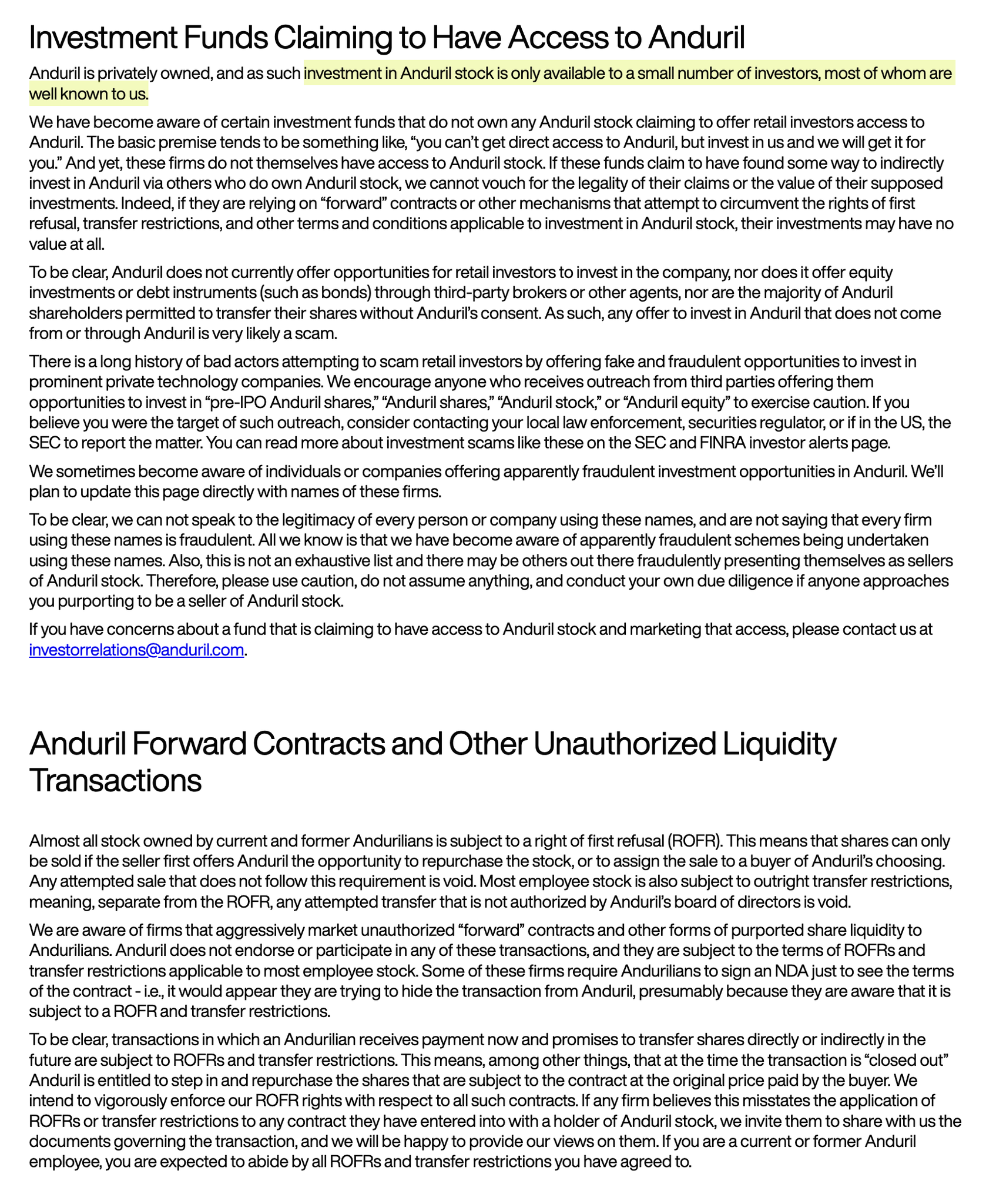
This might be the most elegant way I've seen it done. It provides a lot of clarity; and cuts a lot of the noise and messiness from the market.
How I would have written the Anthropic bulletin
Yes, I know this is presumptuous (who the hell am I, after all?), but I'm writing this with the most constructive of intentions, and hoping that other companies notice and adopt this approach when they gather heat. To make this extra EXTRA clear, I have NO association with Anthropic, and this post is entirely third-party commentary.
Transfer Restrictions
<untouched>
Special Purpose Vehicles (SPVs)
Some investors in Anthropic participate through coinvest vehicles and SPVs organized by their sponsors. However, any SPV or other pooled vehicle holding Anthropic shares — or any interest in Anthropic shares — must be reviewed and approved in advance by our Board, and is otherwise subject to the transfer restrictions in our bylaws.
Anthropic reserves the right to decline any such SPV, but ones we have been inclined to approve have shared these characteristics:
- Organized by a known venture, growth equity, or institutional sponsor with an existing close relationship with Anthropic
- All UBOs (Ultimate Beneficial Owners) participate directly in the vehicle on the Anthropic cap table; sub-syndication, nested vehicles, and "L2s" or "L3s" are expressly prohibited by our Stock Purchase Agreements
- No upfront or "access" fees designed to capture a spread on allocation via brokering, illegal or otherwise
- Beneficial owners are disclosed to us and consistent with our existing investor base
- Are not marketed through unsolicited outreach, messaging apps, or other retail methods
Past SPVs that received Board approval — including vehicles participating in our prior financings and in transactions involving the FTX estate — are not affected by this notice. This notice does not apply retroactively to Board-approved transfers.
For approved managers where we have consented to the formation of SPVs, we have issued them a formal notice on Anthropic letterhead authorizing them to raise up to their permitted allocation under certain parameters and conditions (including but not limited to the ones above). Managers are permitted to share this notice with vetted, bona fide investors under NDA.
Such a notice does not automatically grant a manager a guaranteed allocation; the dynamics of the round, the LP composition, and the relationship between the company and the manager may result in the allocation being cut back or eliminated at Anthropic’s sole discretion. However, we hope that the existence of such a letter will allow an investor to effectively and expediently diligence the manager in question.
Be especially cautious if someone:
<untouched>
Beware of stock scams
<untouched>
Unauthorized firms
As of May 2026, we are aware of the following firms currently marketing access to Anthropic shares or to our financing rounds without our authorization. We have not approved these offerings and do not intend to. Any transfer of Anthropic stock — or any interest in Anthropic stock — through these offerings is void and will not be recognized on our books and records:
- Open Door Partners
- Unicorns Exchange
- Pachamama
- Lionheart Ventures
- Upmarket
Two additional firms — Hiive and Forge — are marketing new offerings of Anthropic shares without our authorization, and any such new offerings are void on the same basis. This does not affect prior transactions on those platforms that received Board approval (including vehicles participating in the FTX estate).
Ask for permission, not forgiveness
We cannot speak to the legitimacy of every person or firm in public, and we are not asserting that every activity by the firms listed above is fraudulent. If you believe your firm is listed in error, or you would like to discuss authorization for a specific offering, please contact us at anthropic-equity-alerts@anthropic.com.
If you believe this characterization misstates the application of our transfer restrictions to a specific contract, we invite you to share the structure, context, and governing documents with us at anthropic-equity-alerts@anthropic.com, and we will provide our views.
Any transactions conducted via an instrument that has not been approved by the Board is by default invalid. And if someone offers you a way to participate, even on an indirect basis, in an investment in Anthropic, the safest assumption is that it is invalid.
The above list is not exhaustive and may be updated. This post will also be updated based on new information, from time to time.
Report concerns
<untouched>
Closing Thoughts
Anthropic is one of the most important and iconic companies of our time. Soon, they'll probably go public and this will all be in the rear view. The point of writing this is that this story keeps repeating itself; and I hope that the next company in this spot benefits from a detailed breakdown of how the private markets play out. I'll be writing a lot more about this area in the future.
If you're an institutional LP or GP who wants to chat about late stage private market dynamics, or coinvesting in the next breakout companies: I'm working on something new in the space, and my DMs are open.