The Least-Understood Company in Silicon Valley
If you ask the typical person in San Francisco what AngelList does, you’ll probably hear “you can invest in early-stage startups on there,” referring to AngelList Syndicates (a product that accounts for less than 20% of AngelList’s revenue).
The other answer you might hear is “the job board thing.” That’s even funnier: AngelList Talent was spun out as an independent company from AngelList (as Wellfound) four years ago.
This is because people understand AngelList's past; but not the rapidly changing present in private capital markets, or the future of the asset class — and the role AngelList plays within it.
Chapter 1: Agency
(And, for some reason, a lot of talk about trees.)
Roots
Before AngelList, there was Venture Hacks, a blog about startups and venture capital started by Naval Ravikant and Babak Nivi. There was no business model; it was a public service to the ecosystem, rooted in two beliefs:
1. Startups are a force for good. 2. Capital is the critical unlock.
They ran informal mailing lists to connect startups with investors. At some point, the runaway volume gave them no choice but to productize the service; and so AngelList was born.
If most startups are carefully planted trees (hence “seed” financing rounds), then AngelList was a result of chaos-seeding. Take take a bunch of seeds, mix them together, and toss them across the soil: you might just get some really interesting saplings.
This happened often at early AngelList. To quote a relevant Venture Hacks post:
The AngelList team is roughly organized into one-person startups. That means we expect you to treat your project like a startup. You come up with the idea, do the design, write the code, release it, market it, support customers, collect external and internal feedback, and then get to work on the next version.
As most startups mature, they grow branches. Some turn into oak companies (wide canopy of offerings), redwood companies (towering presence in a domain), or palm companies (relaxed, good businesses). AngelList was a bit different. The company spawned numerous initiatives, all at the intersection of startups and capital. But instead of staying mere branches, they behaved in a sort of autonomous manner, and many of them grew big enough to put down their own roots.
Kind of like a banyan tree.
The result was dozens of products and brands, all in service of enabling startup capital formation. Some of these are products you might have heard of (Rolling Funds, CoinList, USVC), some are internal operating divisions (Belltower, SAX Capital), some are emerging brands that aren’t widely known yet (Meridian, Nova), and some are purpose-built solutions upon shared infrastructure (Roll-Up Vehicles, Scout Funds, Consolidation Vehicles, the Access Fund).
While it’s common for financial-services companies — Square, Robinhood, even JP Morgan — to be multi-product, those companies support the breadth with thousands of employees. AngelList’s incredibly wide surface area is operated by a team of fewer than two hundred — and the surface area is growing faster than its headcount.
Just like banyan trees (yes, I’m pushing the metaphor right to its breaking point): they grow extremely quickly (a height of 15 feet within a few years), their canopy extends much wider than any other, and they are extremely water-efficient. Give a banyan a decade or more and it doesn't look like one tree at all; it becomes a thicket, dozens of branches and hanging roots in a single ecosystem.
All of this makes can make AngelList a little hard to describe as a single company. It sounds a lot more like…
Two hundred one-person startups
Last year, AngelList CEO Avlok Kohli posted about the idea of a Founder’s Cafe:
AngelList San Francisco office has an open cafe-style area. Should we turn that into an actual cafe for founders to work out of?
People loved it. Irin Son (AngelList’s head of people) volunteered to make it happen. Two weeks later, Avlok tweeted that the space was open.
Around 2021, product lead Sumukh Sridhara got excited about products for founders. He and Dan Hightower (who had just left Carta) worked on a suite for founders, ranging from Roll-Up Vehicles to a cap table product. When the work picked up enough traction to stand alone, it spawned Rollups, a 10-person division that runs like a self-contained startup. Besides RUVs, they have shipped Consolidation Vehicles and Secondary Vehicles. These products have the same core, powered by AngelList’s expertise with SPV administration, at compelling price points enabled by scale; but they are customized to highly specialized use cases making them very easy for a customer to adopt.
Until early 2023, AngelList’s bank accounts and investor wallets were once powered by SVB. They were a great partner until that weekend in March a few years ago (a weekend that founders and fintech people would rather not relive).
In the months that followed, like many other fintechs, AngelList went looking for a replacement. But they were looking for a slightly different partner bank this time: a G-SIB (Global Systemically Important Bank), the kind of institution which is essentially immune to macro conditions because of the regulatory backstop they are afforded.
One day, Avlok was catching up with Aryeh Friedman (AngelList’s general counsel).
Aryeh: “Hey Avlok, we’re aligned on terms negotiated with BNY Mellon!”
BNY Mellon is one of just eight US-based G-SIBs.
Avlok: …
Avlok: “I thought those conversations died months ago.”
Aryeh: “They did; but I just sort of kept working them in the background, and we were able to get there.”
Today, AngelList partners with six banks, including two G-SIBs (BNY Mellon and JP Morgan Chase) — just because Aryeh refused to give up.
A decade ago, Erik Syvertsen joined AngelList as general counsel. Like many AngelList employees, he was drawn to the mission: make it possible for mom-and-pop investors to access startup investments. And that means even unaccredited investors, who don’t pass the net worth or income thresholds required for venture investing. This was simply not possible at the time. And it wasn’t, for a while after — close to a decade, in fact. But Erik kept the flame alive, and kept chipping away at it as a “side project” to his day job (as the company’s head lawyer). When regulatory environment changed with the new administration in 2025, the AngelList team was already ready. USVC launched in April 2026.
Horrifying lives
This pattern is everywhere at AngelList: initiatives big and small (some amounting to a company’s worth of work), pulled off by single-minded individuals.
Irin had an amusing way of describing people who thrive in this sort of environment. “Sometimes, the happiest people lead horrifying lives.” While I laughed, she continued, “Some people are so obsessed with things they’re passionate about, that normal people can’t help but think ‘are you okay?’ But they’re not just okay… they’re self-actualizing in this mode.”
Erik has a (healthy? unhealthy?) obsession with extreme sports including, apparently, uphill skiing — an activity I was not aware was feasible. Much, I suppose, like launching a registered investment fund for unaccredited investors. His favorite phrase is “steer into the pain.”
Prad, the head of product, wears the same shirt every day, even to client meetings and happy hours. The running joke is “have you reminded him to eat today?” because he usually forgets unless someone coaxes him to, or literally orders him the food. (While other people focus on the diet, I’m working to dissuade him from wearing anything with 94% polyester every day.)
Prad joined the team when AngelList acquired the company he founded. He thought he’d maybe stick around for a year or two (most founders feel the itch to start a new company after a couple of years at an acquirer). It’s now been more than three years, and he doesn’t see an end in sight. “There’s some process, but way less than I would have thought. It feels like we intentionally create spaces where alignment is not necessary. Plus there’s so much to do.”
When alignment is needed, it isn’t painful. A big part of the reason is that everyone — regardless of role — seems expert in the domain. Titles appear to be suggestions, not specifications. In one meeting I attended, the GC (Aryeh), Head of Eng (Andrew), Product Lead (Connor), and Head of Product (Prad) all code-switched between product, engineering, partnerships, operations, pricing, and legal. I couldn’t guess their roles without looking them up.
“It’s reminiscent of Jaya Gupta’s post,” Irin said.
Great companies… are structures that let a certain kind of talent finally express themselves. A great company gives them a language for their own ambition. It says: the thing you have been circling around but have not known how to name can happen here.
That almost sounds like it could have appeared on Venture Hacks.
Never let go of a soulmate (or a pragmatic corporate counsel)
Much of this is not unique for a startup. There are quirky people at every company. We’ve all heard of people who wear one outfit to dodge decision fatigue. Empowered cultures exist at OpenAI, Cursor, Anthropic, and many others. Loads of hackathon projects have become products. Books have been written about Google’s 20% time.
But none of those companies are operating in financial services. AngelList’s products involve securities law, banking, tax, custody, accounting, and the movement of other people’s money. In this domain, permissionlessness has consequences.
But at AngelList, the lawyers are in on it. Erik joined AngelList as General Counsel. Aryeh is the General Counsel today. At most companies, legal is responsible for saying “no.” At AngelList, they ask “why not?”
This works for two reasons. First, the culture expects and trains every engineer and operator to wear the legal and compliance hats, too — so the lawyers can rest a bit easier knowing that everyone is sharing the mantle of responsibility. Second, so much compliance infrastructure has been built over time that there are very few “new” legal questions. Roll-Up Vehicles were not built from scratch; they were a specialized flow on top of an existing API call to form an SPV. It all reminds me a bit of early Amazon — two-pizza teams that moved fast because they could communicate via internal service interfaces, not meetings.
Back in ~2018, I heard a story from Jake Zeller, who was early at AngelList.
“We’re a highly engineering-centric company, we made that decision early on. Yeah, we operate in fintech, but the engineers call the shots. We had a lawyer insist on an e-signature instead of a clickwrap. The engineer on the project was adamant, he would absolutely not degrade the user experience by loading a fucking PDF and making a user sign that. The lawyer retorted ‘how many 506(b) issuances have you done?’ That lawyer is no longer with the company.”
I found the tension Jake identified fascinating. In hindsight, I think there was another dimension besides “engineering versus legal” at play. I think it was agency versus authority. It just so happens that a lot of engineers operate with agency, and a lot of lawyers default to authority… and it took a few tries for AngelList to find the lawyers who operated with agency.
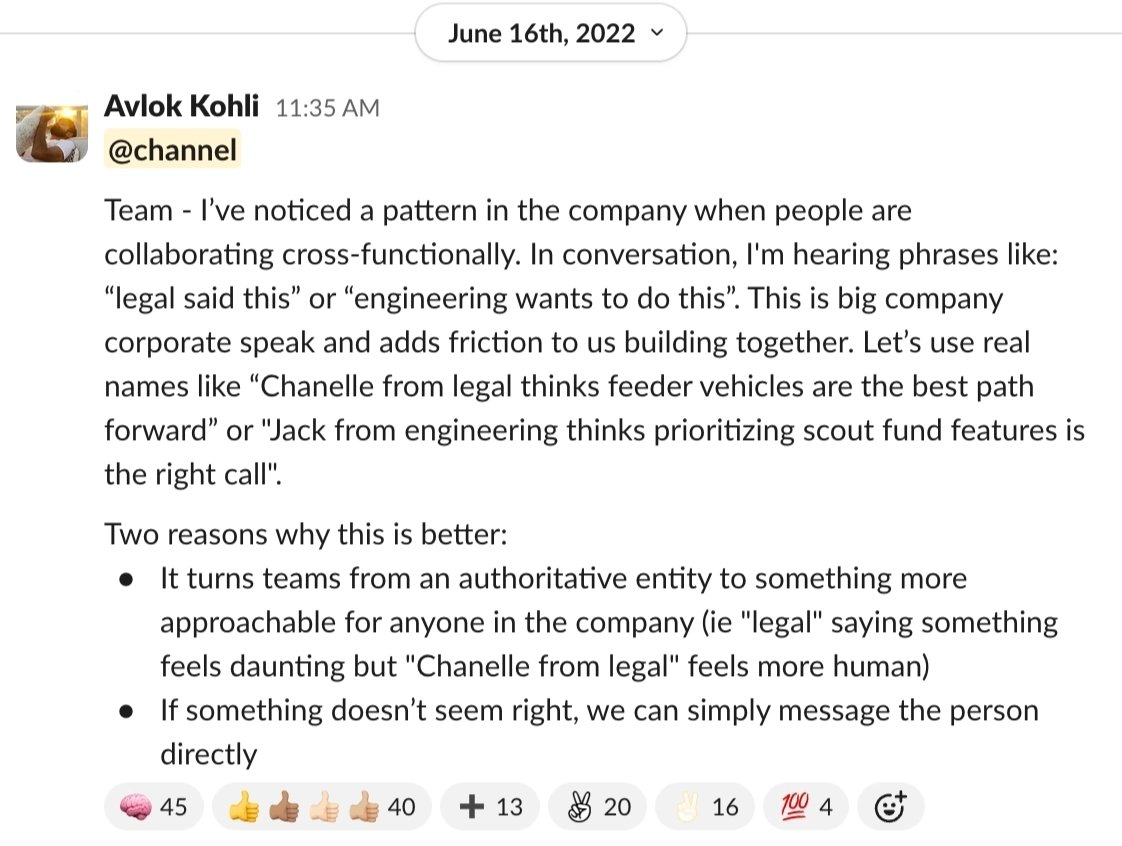
This post embodies several principles Avlok believes deeply. “One, sunlight is the best disinfectant. Two, deference to authority is a big pet peeve of mine. Third, it’s not legal or compliance’s job to say no. We figure out how to make things work. If something is not possible with the accounting infrastructure we have, we build it. If something is not permissible under current regulation, we work with DC to change it.”
The downsides
So far, this post has waxed poetic on the “free radical” culture, but every culture comes with a cost.
- Identity diffusion. When the company is many things to many people — even successfully so! — it’s harder to tell the story to customers, to candidates, and sometimes even to remind people of it internally.
- Key-person risk. When a project is the brainchild of one talented person, it blooms under their unbridled attention. But it also wilts when they must turn to something else. If they leave the company, their project might just die of neglect.
- Uncaptured value. Avlok remarked dryly that the company is the most undermonetized business in Silicon Valley. Great work can happen in sprints, but value-realization comes from doing — and being — the same thing for a very long time.
The re-founding
These were not theoretical problems. The very thing that makes a banyan tree (yes we’re back to this analogy) strong and wide-canopied makes it prone to overgrowth.
In 2019, Avlok Kohli took over as CEO and put AngelList through what he calls a “re-founding.” Over the next few years, the company pruned product lines that ate bandwidth but didn’t move the needle (“strategic distractions,” as Avlok calls them) and reworked the business model around free cash flow. The goal was to point the company back toward its original organizing principles:
1. Startups are a force for good. 2. Capital is the critical unlock.
A big-company CEO might have responded to too much autonomy by curbing autonomy. Centralize the roadmap. Drive alignment. Stop letting people disappear into side projects.
Avlok did not do that. He just added one rule: “I’m okay with people sprinting after their passions, as long as it’s high upside. It can be low probability; but it has to move the needle. Any new project needs to at least have the potential to be company-sized.”
Strangely, that "constraint" is more empowering, not less. It forces people to think bigger. This wouldn’t work at most companies; there just isn’t enough whitespace. “Company-sized” would eliminate most ideas. Not so in private capital markets; this is a nascent asset class, missing wide swaths of infrastructure. It’s almost all whitespace.
To understand what’s missing, it helps to compare against the landscape in more mature capital markets.
Chapter 2: Ledgers
(A chapter in which I become alarmingly emotional about accounting and reconciliation.)
The public financial markets are a wonder
When you click buy on E-Trade, that trade is touched by dozens of market participants: brokers, prime brokers, the DTCC & NSCC, market makers, custodians, accountants, exchanges, clearing agencies, data processors, trading desks, ratings agencies, dark pools, alternative trading systems…
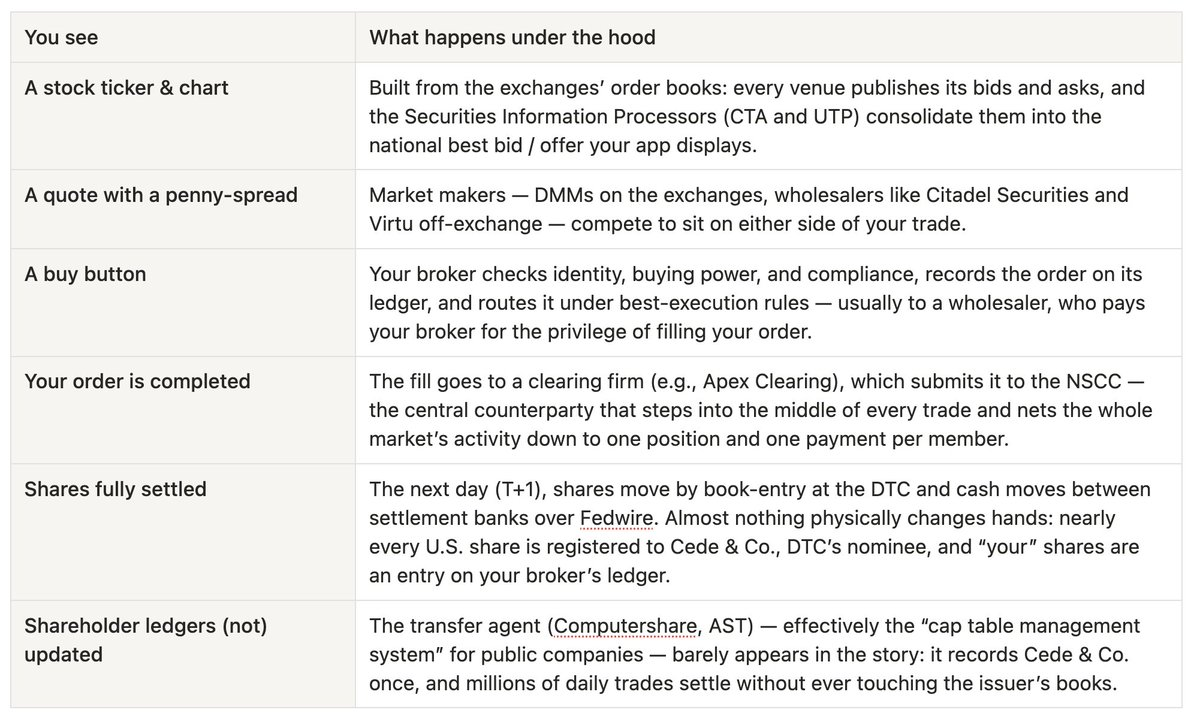
Here’s a (very very simplified) version of the public market trading stack:
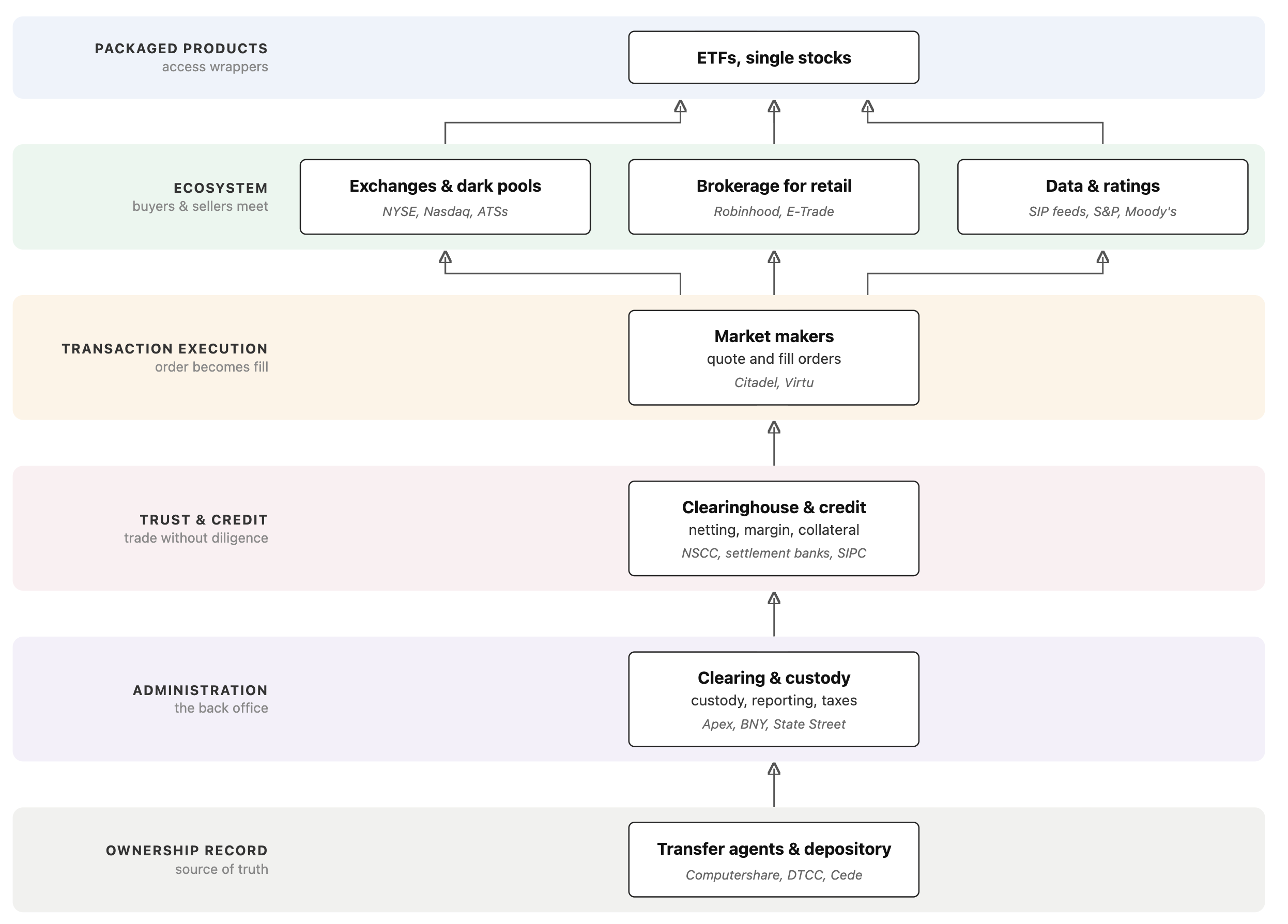
The fact that you can just go buy equity in Nvidia in a couple of clicks is beautiful. You can participate in a company that powers the most important economic and technological innovation of our time, with zero apparent friction, with a greater degree of trust and liquidity than buying a banana at the farmer’s market.
It’s accessible to just about anyone. And somehow, we built stuff that made it cheap enough to execute and settle that it’s worth everyone’s time to let people buy a fractional share, paying $5 for 0.000000000001% of a company.
It’s easy to take it for granted. But we shouldn’t. In moments like these, I’m reminded of John Collison's wonderful post:
As you become an adult, you realize that things around you weren't just always there; people made them happen. But only recently have I started to internalize how much tenacity *everything* requires. That hotel, that park, that railway. The world is a museum of passion projects.
Emergent machinery
Public markets did not arrive fully formed. Their machinery emerged over 150 years, and similar functional layers have appeared across complex financial systems.
The order varies with path dependence and regulation. The relative importance of each layer changes with the underlying asset and its participants. But the functions tend to converge. Take another look at public markets:
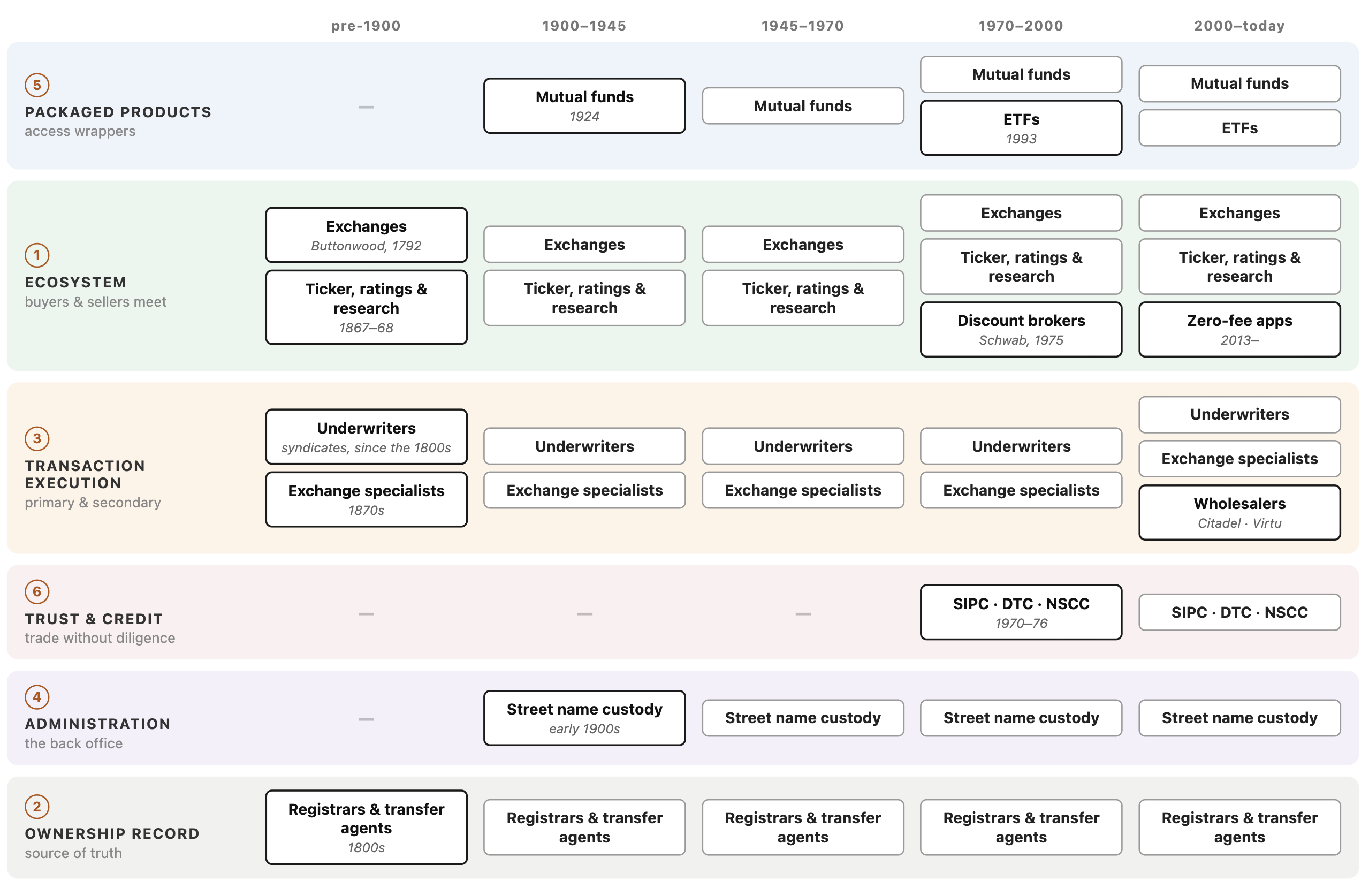
We've seen the same thing happen organically in newer asset classes like crypto, too:
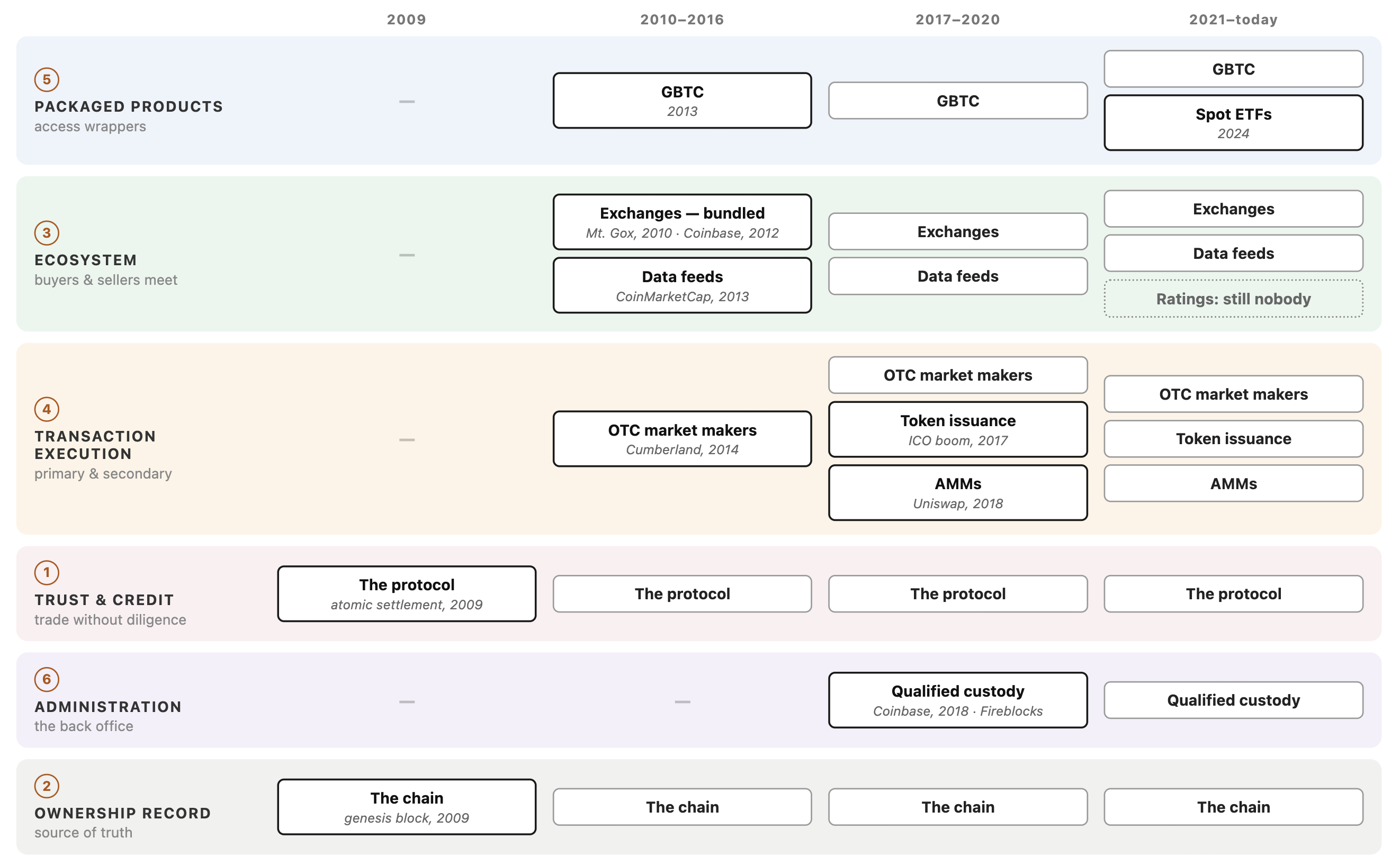
It’s ledgers all the way down
A mature asset class needs two things.
The first is legibility. Access to information — data, ratings, and research — lets a transactor make an informed decision. Packaged financial products allow a non-professional investor to trade on their “thesis” with minimal effort.
The second is trustworthy execution: confidence that a trade will execute at a fair price, predictably, without egregious cost or friction.
In the absence of those things, assets are a pain in the ass to trade.
Imagine if every time you bought a share of Apple stock, you had to review and sign a (custom) contract, then Schwab had to contact the finance or legal team at Apple HQ in Cupertino for sign-off on every single trade. Very few transactions would happen; bid/ask spreads would probably be very wide; fees would be absurd; many transactions would die before consummation (”time kills all deals”).
The result would almost certainly be a sky-high minimum for a transaction, perhaps $100,000? Maybe even $1,000,000?
This leads us to a few natural conclusions:
- Liquidity and accessibility are not separate goals; they are one and the same, two sides of the same coin. Financial markets become more accessible when they become more liquid.
- Markets become more liquid when there is more indirection in the system (i.e., you don’t have to update a single global ledger). - In public equities, the “issuer” (Apple) or the “transfer agent” (Computershare) almost never gets involved. This is because issuer → transfer agent → prime broker / custodian → broker → shareholder is several layers of indirection. A transaction can settle at any of those layers, which dramatically increases liquidity. - In crypto, Bitcoin was designed for trustless settlement, which makes the whole plumbing a lot easier. And we still ended up with the Lightning Network, custodians like Coinbase, and other layers of indirection to ensure scalability, speed, and efficiency in the system.
- Indirection only works if ownership is validated, which means each layer must be reconciled routinely and flawlessly.
Every financial market I can think of is powered by reconciliation, reporting, and accounting. It’s all just ledgers.
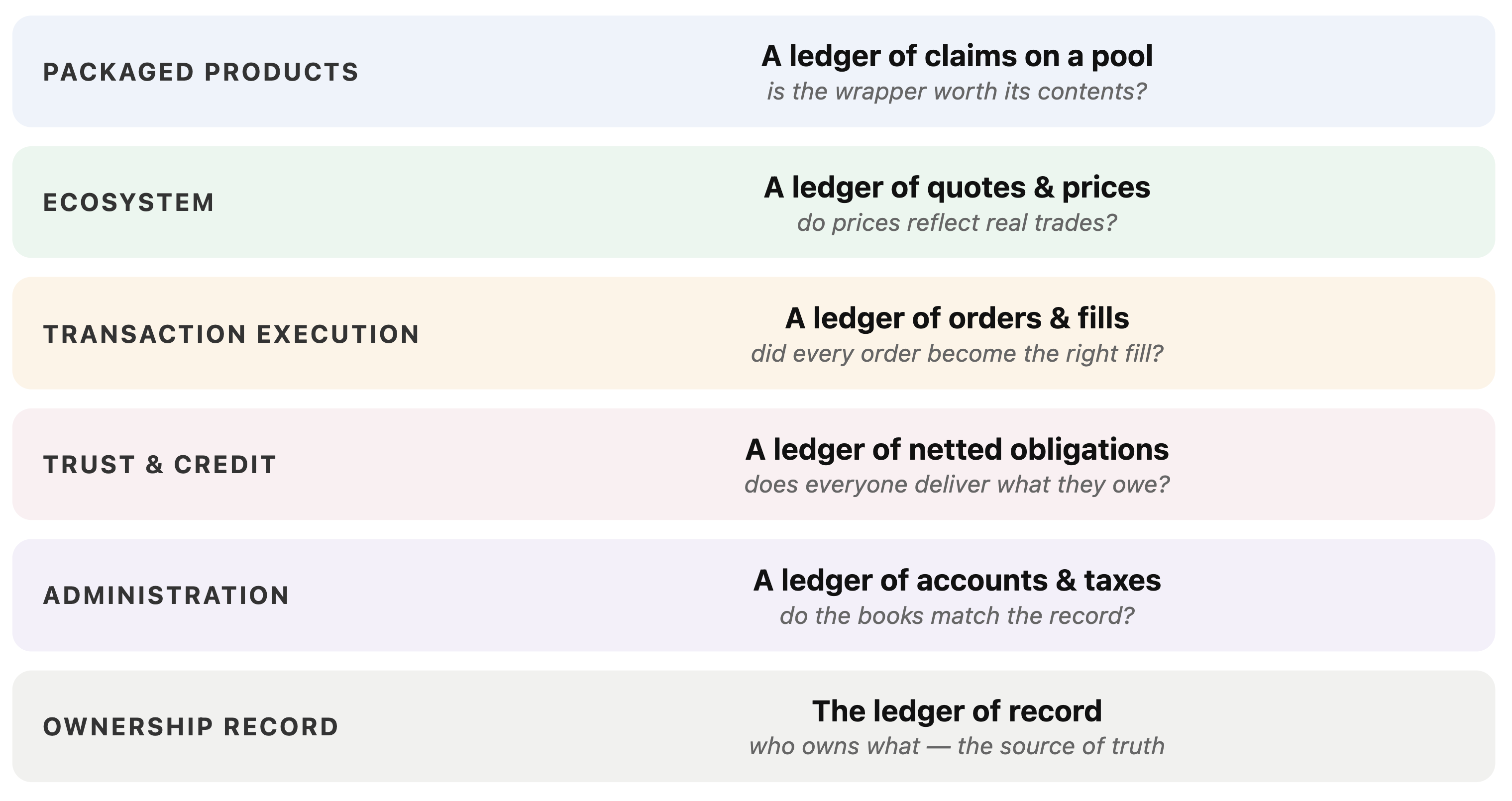
That was pretty eye-opening for me. I conceptually understood the importance of accounting to financial markets; but I didn’t realize that reconciliation isn’t merely important, it’s everything. And it’s not just important to finance nerds, it’s important to liquidity — something that touches every consumer and market participant.
Which means that automated reconciliation is the single most important unlock for indirection. Indirection begets liquidity. Liquidity begets access.
That’s the ballgame.
Startups & VC: an (ironically) analog asset class
For the first fifty years starting in the 1960s, venture capital developed slowly. There were General Partners (“GPs”), who served as the underwriters, the closest analogue to exchange specialists or market makers. And there were fund administrators, who provided services to those GPs. Not much else changed for a long time.
In the last 15-20 years, a lot of things started happening at once: data feeds, syndicates, cap table management, secondary brokerage platforms, novel structures, diversified baskets.
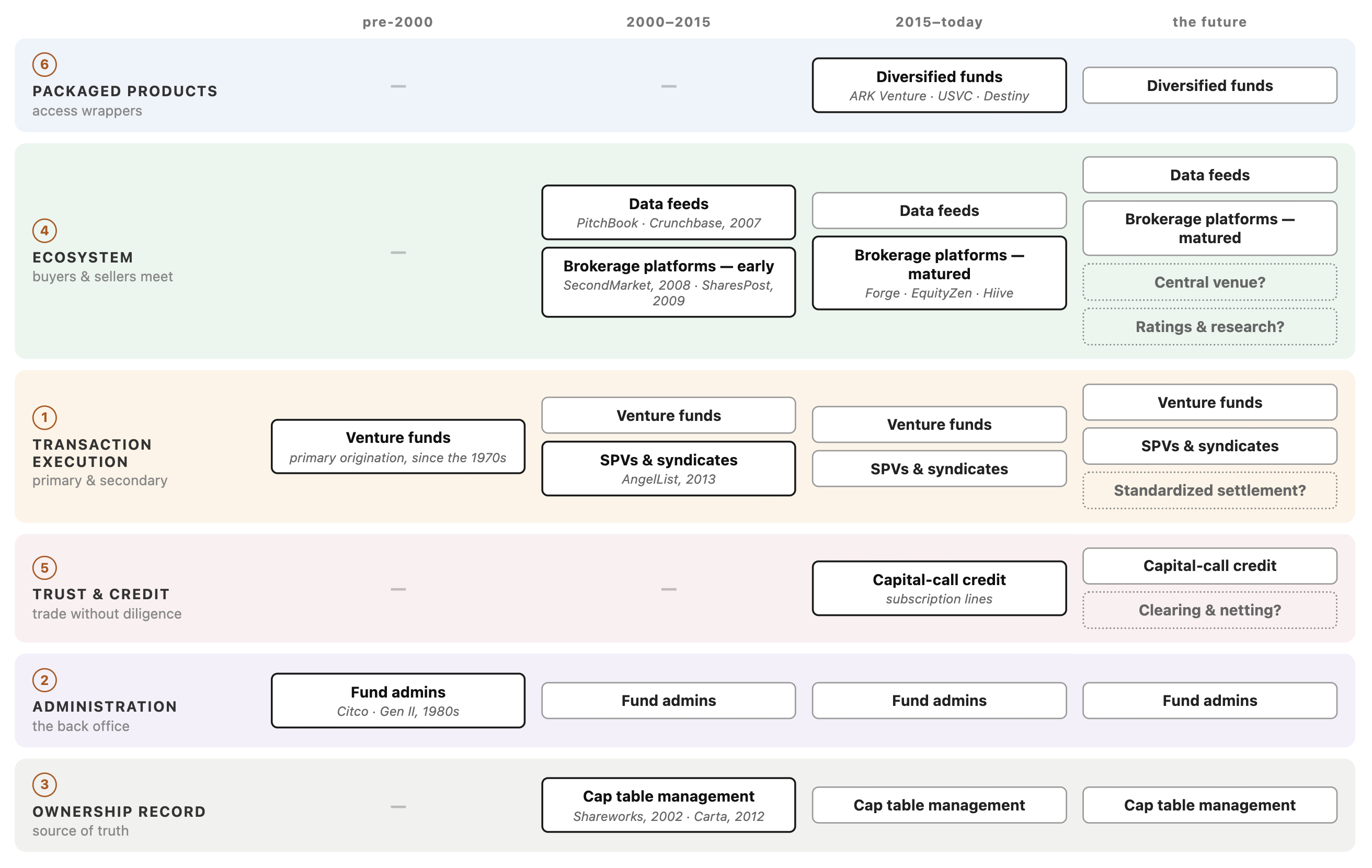
Despite the wave of recent changes, several barriers have kept this asset class from maturing:
- Venture Capital is a very insular, insider community. Trust is managed through relationships, rather than being encoded or systematized (somewhat ironic given Silicon Valley loves to automate everything). This has been a good thing in many ways! But it doesn’t “scale.”
- A long tail of “SKUs” and poor legibility. Startups have historically been dispersed across tens of thousands of companies, with little disclosure of valuations or financial metrics.
- It’s an unusual, power-law asset class. Outcomes are unpredictable, and take a decade to play out. Carried interest is the price of entry for access. This is relatively unusual and often a source of friction.
- There is limited infrastructure. There is very good infrastructure to serve VCs (fund admins, data providers, SPVs), but not much to serve companies (cap tables, and not much else), and nothing for any other market participants (external investors / LPs, angels, shareholders).
- Issuers (mostly) frown on liquid markets. Be it primary syndication or secondary transfers, companies aren’t thrilled about any developments in the markets for their stock.
Chapter 3: Ownership
(In which markets, infrastructure, people, mission — and trees! — come together.)
All of this is changing as we speak
In just a decade since 2015, the market has ~20xed on every metric: from 80 to 1,500 unicorns; $300B in market cap to $6T; and VC funding from $20B to $400B+.
A durable cohort of a few dozen late-stage companies has emerged — Anthropic, OpenAI, Stripe, Databricks, and Anduril among them — against tens of thousands of early-stage companies.
There is also more information than ever: companies now freely disclose valuations, and increasingly revenue and growth rates.
Most importantly, companies are slowly coming around to the need for a robust capital formation ecosystem. SPVs — with company knowledge — have become a commonplace way to fill the gargantuan financing rounds that the late stage demands. The most stable companies (Stripe, Canva, Databricks, Revolut, and until recently SpaceX) held regular tenders to vent liquidity needs. And alongside “real” GPs, we are seeing the rise of pseudo-GPs, who act less as underwriters and more as proxy capital raisers for their portfolio companies.
The most prominent side effect is the rise of the SPV ecosystem. With no abstraction above the cap table, SPVs provide a crude layer of indirection. It’s painful because of the immaturity of the asset class: transparency and legitimacy are sorely lacking. But the Wild West will give way to orderly practices as such infrastructure forms.
The old rails are groaning under their own weight. A land grab is underway: legacy administrators and tech-native entrants are expanding into one another’s territory, launching new products, and racing to rebuild their operations around AI. Meanwhile, capital markets activity is shifting among mega-funds, emerging managers, SPVs, brokers, and family offices galore.
If we look at the same layers as before:
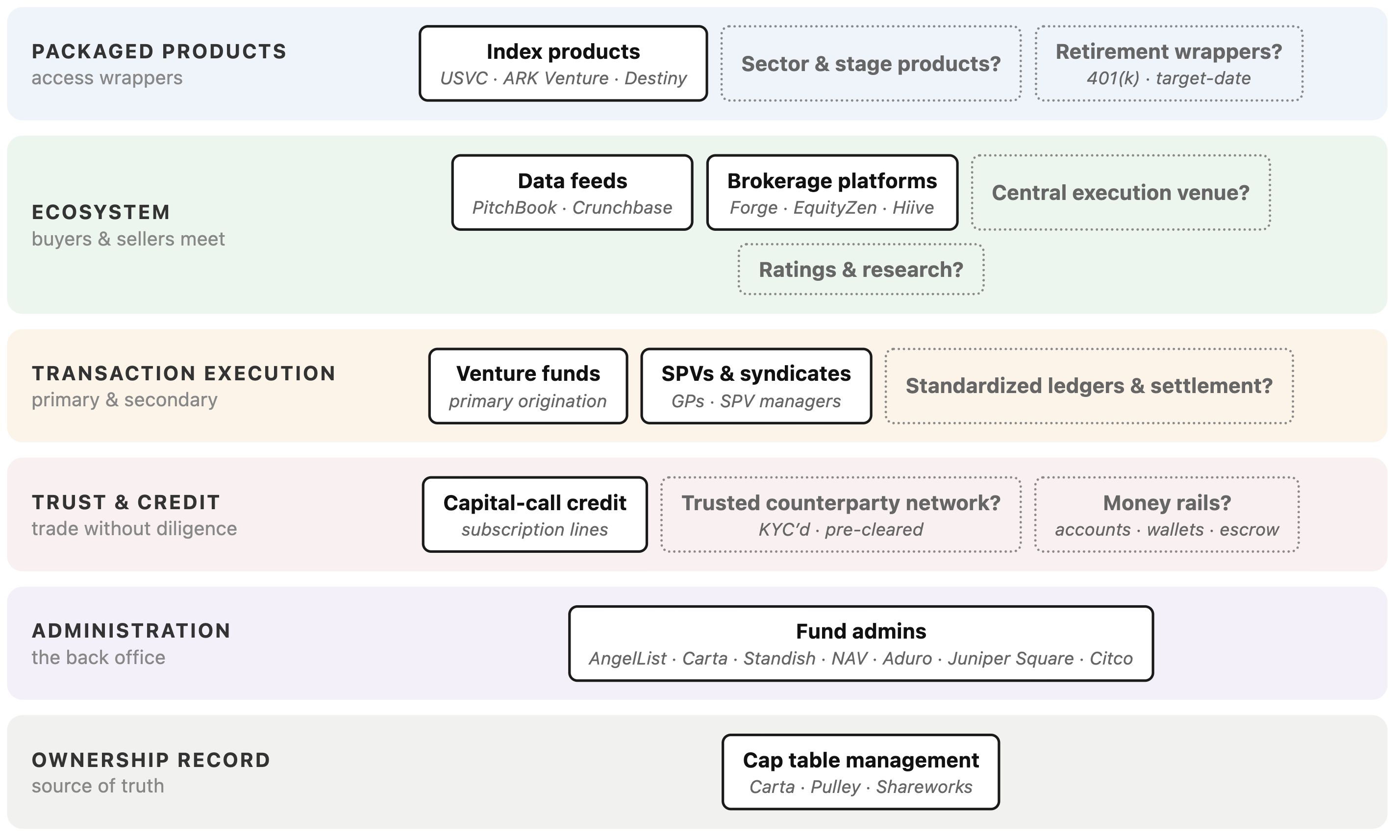
Cap tables have largely solved the ownership record: Carta, Pulley, and Shareworks. There are fund administrators for every size and type of fund (while many could use modernization, they are largely good at what they do).
But all the layers above are long overdue.
When capital meets code
The missing layers — particularly the next two (Trust & Credit, Transaction Execution) — cause an incredible amount of friction:
- Most transactions require fresh KYC (Know Your Customer) and AML compliance. You have to call someone to verify wire instructions before you trigger funds. Don’t even get me started on escrow mechanisms.
- Counterparty legitimacy is a constant fear. Unless it’s a top-tier VC, every deal raises the same question: “Is this buyer real, or are they stringing me along?”
- There is a huge discovery problem with “allocation”: there is no way to verify that a transaction actually closed across every “layer,” all the way down to the company.
- Transactions — primary and secondary — remain extremely time-consuming (weeks or months) and expensive (thousands in legal fees).
This needs to be fixed. And this is where AngelList is betting all of its chips.
Imagine a private-market transaction in which every participant is pre-KYCed and identity-verified; every entity can show proof of funds instantly; a binding order is placed with a few clicks rather than a 50-page DocuSign; and funds move instantly between counterparties.
Every transaction would be an order of magnitude more likely to close.
Well — this is already how LPs subscribe on AngelList. You look at the deal / fund page. You review the deck and data room. You enter the investment amount, select the investing entity, click a couple of checkboxes and hit submit. If you are transacting with an existing entity, you’re pre-KYCed, and your bank account is already hooked up for an automated ACH from your external bank to your AngelList “funding account.” I’ve invested on AngelList in under 60 seconds.
AngelList therefore has an almost unfair head start on solving these next two layers. It already has years of identity, entity, fund, banking, and transaction data across a large network of GPs and LPs, plus the infrastructure to move and reconcile money.
But only a fraction of private market transactions run on AngelList. Other experiences are typically more janky and painful.
A Whole Nova World
Enter Nova: a new AngelList product to serve as a shared trust & credit layer across the private markets. Nova lets any fund administrator offer subscriptions, LP portals, bank accounts, and money movement on AngelList rails.
When I first heard about this strategy, I was confused. AngelList’s biggest business line is fund administration. Why would it give away its edge — the differentiated tech and automation — to other admins?
Because capital markets infrastructure is a network effects business. The only way to solve the problem and crack the market wide open is to build industry-wide protocols. And protocols don’t work unless a critical mass of participants also opt in.
But once they do, and more capital and counterparties start flowing through the protocol, it unlocks both network effects and new products on top, and you can monetize those: banking, capital call credit lines, and new packaged financial products, for starters.
That is worth the risk of disrupting the existing business.
Okay. The path for AngelList is risky, but the benefit is clear. Now I would imagine fund admins would also be wary of embarking on such a partnership. Why did they agree?
The reason was the changing market landscape. The explosion of volume, LPs, distributions, share transfers is getting overwhelming without better automation. In the meantime, Carta, Juniper Square, and other new entrants were hell-bent on replacing incumbent administrators completely; AngelList was offering to make them more competitive without interfering with the underlying customer relationship. The enemy of my enemy is my friend.
As a sweetener:
- The same products that AngelList is monetizing (especially banking) also let administrators generate additional revenue.
- This enables administrators to immediately upgrade the quality of the software experience they can provide GPs and LPs (without a massive investment of time and money).
- As a bonus, this gives incumbent fund admins better internal automation from AI (again, without having to build it out themselves) — improving their own margins while delivering better outcomes to customers.
We’ve seen this before with other industry alliances and networks. NACHA was formed when banks were concerned about the growing volume of paper checks. The DTC was created out of the “paperwork crisis” of the 1960s, to transition public markets to an electronic book-entry system.
These networks are great! Every market participant benefits from a shared trust layer! It’s a clearly positive sum game! But opting into a shared network is a classic prisoner’s dilemma. It requires each participant to cede some control and trust other market participants. It takes years of relationship building, and extensive partnership agreements to ensure everyone feels protected. It is a chicken-and-egg every step of the way.
AngelList was able to get there thanks to the confluence of market conditions, competitive threat from full-stack entrants, a beneficial value proposition, sheer force of will over a long time, and… yes, a little luck. The entire industry will be better off for it. Each additional administrator brings more GPs, LPs, verified entities, and capital flows onto the same rails… making those rails more useful to every other participant.
A stake in the future
The companies defining this era increasingly accumulate enormous value before reaching the public markets. Billions of consumers and hundreds of millions of professionals use products made by private companies: OpenAI, Stripe, Revolut, Ramp, Canva. And yet, the privilege of ownership in those companies is available to a fraction of a fraction of those people.
To go from “thousands of people can buy a share of stock” to “millions of people can buy a share of stock,” we need to make identity, signatures, custody, accounting, money movement, reporting, and compliance work at scale.
That’s why USVC matters. It is not the culmination of AngelList. But it is a milestone, and an important one: proof that the end-to-end infrastructure works. Sometimes, when a banyan branch sends a root into the ground, that root thickens into a new, self-sustaining trunk.
It is poetic that this product embodies every theme we have discussed in this post. A single person driving an improbable initiative for a decade — his gift to the world’s museum of passion projects. A culture that allowed, even encouraged, him to keep going, because the upside made it worth it. Infrastructure built by hundreds of people over more than a decade, brought to bear on a problem that seemed impossible until just a few years ago. A mission given flesh in the product: to give everyone a stake in the future of technology.
USVC is one product, at one layer, of a financial system still in its adolescence. There is much work to do yet. The rails must become more trustworthy. Execution must become cheaper. Opportunities must become more legible. Only then can we expand ownership and access.
People feel differently about change when they have a stake in it.